Insights · ProCast
Episode 25 — Proscenium at 15: A Look at How We Got Here
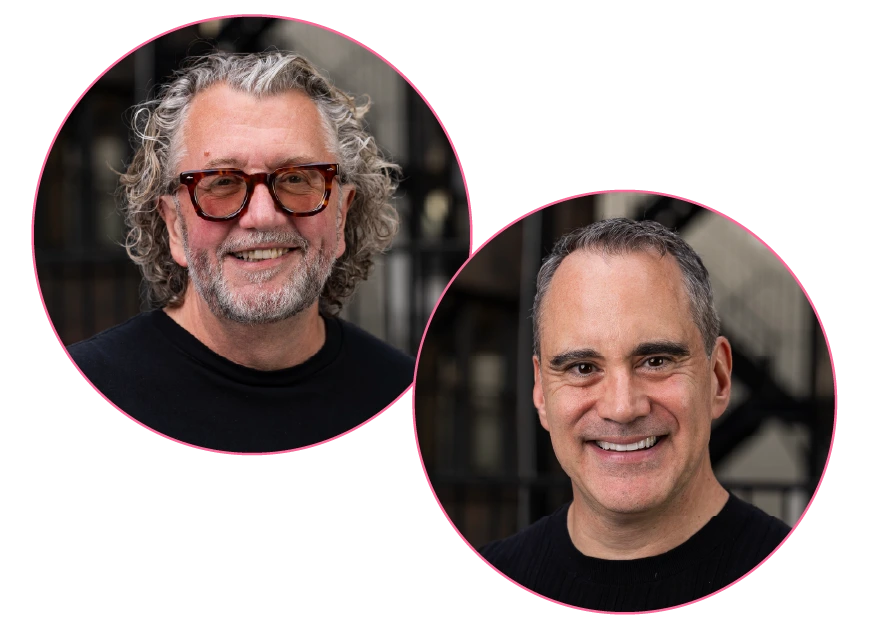
This episode was 15 years in the making! We’re talking with Proscenium founders Mark Shearon and Chuck Santoro. In recognition of the 15th anniversary of Proscenium, Mark and Chuck take a look back. They revisit the early days, the risks, the wins, and the stories that never made it into a pitch deck.
This episode is also our FIRST EVER video podcast, scroll down to watch it in living color. If you want to listen as usual, then hit the download button, screw your headphones on tight, and get ready to take notes.
Read the transcript below and listen to this episode on Apple Podcasts, Spotify, YouTube Music or wherever you get your podcasts.
Show Notes
Guests
Chuck Santoro draws upon his marketing and theater background to bring insight and creativity to meetings and events. He is an expert speaker coach, has a keen eye for design, and excels at understanding brands and branding. Chuck always finds ways to represent the brands he works with in ways that are unexpected and exciting. He has directed talent such as Ben Stiller, Viola Davis and Harry Connick Jr. He has led the creative for brands such as Bank of America, Boeing, Harley-Davidson, JetBlue, Nintendo, Novartis, Pfizer, Qualcomm, TD Ameritrade, T-Mobile, and Walmart.
Mark has spent the last 30+ years thinking about his clients, opportunities, and solutions. He has a way of strategizing with brands that cuts right to the heart of the issue. He can then find innovative and cutting-edge solutions that bring brands to life in the live, virtual and hybrid arenas.
He has worked with the world's best-performing brands on some of their most important communication and marketing programs. These include Qualcomm, Univision, Heineken, Harley-Davidson, T-Mobile, Facebook, SAP, American Express, Walmart, Ford, Aston Martin, Jaguar, Land Rover and Lincoln. He has worked globally and on both sides of the pond in London and New York.
Credits
Hosted and Written by Jeremy Dobrish
Produced by Bethany Potter
Theme Music by Mike Mancini
Logo design by Shraddha Maharjan
Special thanks to Dossie McCraw
Transcript
Episode Transcript
Guests: Mark Shearon & Chuck Santoro
JEREMY: Hey there, thanks for tuning in. I'm Jeremy Dobrish, and this is the ProCast, brought to you by Proscenium Events in New York City. It's a podcast about corporate events. Each month, we take a bite-sized look at how to make corporate events, conferences, programs, and shows even more effective and impactful.
Today, we're doing something a little different. This is our first-ever video ProCast, and this episode is all about celebrating Proscenium's 15th anniversary. So maybe it's not as packed as usual with actionable takeaways, but if you've ever wondered how and why Proscenium got started, what some of the challenges were, and what makes Proscenium so special, then stand by for cue one of the ProCast. Cue one, let's go.
JEREMY: So I'm here with two of the founding partners of Proscenium, Chuck Santoro and Mark Shearon, and we're here to celebrate the company's 15-year anniversary. Hi, guys.
CHUCK: Hi. It's nice to be here.
MARK: Hello.
JEREMY: I'd say welcome, but we're already here at the Proscenium offices.
CHUCK: Thanks.
JEREMY: So let's go back to the very, very beginning.
CHUCK: It's a very good place to start.
JEREMY: Isn't it? At the time, you both had very successful careers producing live events. You were at one of the top agencies to do this. You had great titles, great offices, and yet you decided to go out on your own and start your own agency. What the hell is wrong with you? Why? What did you think you could do better or differently? What were your goals?
MARK: I think that was it. We felt there were some things that weren't right at the other agency, and that we could do it better for the clients, better for the people who worked there, and generally just do a better job. I'll speak for myself: I felt we tried to make some changes there and it hadn't really worked. So we said, "Okay, we should stop talking about it. If we think we can do it better, we should just do it." That's really the start of it.
JEREMY: What kinds of things? Give me a specific example or two, Chuck.
CHUCK: There was such bureaucracy where we were. Mark and I had both been at other huge agencies before that, and we learned a lot, but there was always that sense of not having the final say. Sometimes we felt like the decisions upper management made weren't serving our team or our clients. There were a few times when Mark and I worked on projects together where we thought, "If we could do things differently, we would," but our hands were tied. So when the opportunity arose, we realized we could actually do all the things we'd always said we wanted to do.
JEREMY: I'll add to that, because Proscenium is the only live event agency I've ever worked at, so I don't have a comparison. But from two perspectives: in terms of clients, you both have a level of care that I find hard to believe exists elsewhere. The level of detail, the lengths you'll go to, it's the furthest thing from cookie-cutter or phoning it in. And as a staff member, the care you have for your people is extraordinary. You take care of us unbelievably well. I know it's hard to say these things about yourselves, but I can't let it go unsaid.
MARK: Certainly not in my experience. And going back to your original question, that's why we decided to do it ourselves. What we did was a little unusual, in that we didn't start with what we wanted Proscenium to be. We started with what we didn't want it to be. We didn't want it to be anything other than for the benefit of our clients. We didn't want it to be dishonest in any way. We didn't want it to be highly bureaucratic for the people who worked there. We wanted people to have good healthcare. We wanted people to feel like they were part of something special. So it started with what we'd seen in the past that didn't work, and making sure that was taken care of at the new agency.
JEREMY: Makes sense. Doing something like that is very difficult. What were some of the obstacles or challenges you faced along the way?
CHUCK: At first, and I'll give Mark the credit, it was his idea. He said he had this crazy idea, and, no surprise, I was busy with T-Mobile. I said, "Hey, Mark, sounds great, but I've got this T-Mobile thing." He really took the ball and ran with it. Before it actually happened, there were a lot of stumbling blocks people don't even realize, in the two years leading up to it. One was: who's the right partner to fund us? To be totally honest, our first partner didn't work out. All these years later, thank God it didn't, because everything happens for a reason. But at the time, our first partner wasn't upfront or trustworthy, and we didn't know that. We were lucky it got us our start, but right away it wasn't, "Oh my God, everything's great." Six months in, we didn't know if this was going to last.
MARK: By "partner," he means investors. The biggest obstacle was money. It was as simple as that. We were leaving well-paid jobs. I had small children at the time.
CHUCK: We had really nice offices. Mark had a beautiful corner office overlooking Times Square, overlooking the ball drop, and I was right next to him. It wasn't awful. We were making good money and really liked our teams. But we knew there were things we thought we could do better.
MARK: We needed to raise funds to start the business, and we didn't have that money ourselves. Banks won't lend you money for an idea like that, because you have nothing to lend against. Of course, now we get offers from banks every day. So we needed investors. As Chuck said, I took that on. It probably took two and a half to three years to come to fruition. We went out to three or four different partners, some of whom we still know. Once we got that funding, we could start the business, and we did that on June 8th, 2011.
JEREMY: And what about along the way? What's been challenging or tricky?
MARK: Pretty quickly, and not to spend too long on the past, we had investors. We opened in June 2011. On December 21st, 2011, they said they'd run out of money and could no longer fund us.
CHUCK: Merry Christmas.
MARK: Merry Christmas, everyone.
JEREMY: So fun.
MARK: That was interesting. We took huge pay cuts. We emptied our piggy banks and put everything we could into the business.
CHUCK: And just crossed our fingers and hoped the new year would bring opportunities.
MARK: And we were fortunate. We won a client we didn't know at the time would be so important: Qualcomm. That saw us through the first year, and then we started adding other clients.
CHUCK: Then there was a huge RFP for T-Mobile.
MARK: T-Mobile, TD Ameritrade, and others started to come in. But Qualcomm really saved us. And they did it twice, actually, then and again during the pandemic, when they were one of our biggest clients. So, thank you, Qualcomm.
JEREMY: One of the things I think you both do incredibly well: it's challenging from year to year. You don't know how many shows a given brand is going to do, what budgets they'll have, or what new shows might come in. You're balancing that uncertainty against the staff you've got, and pretty much every year the staff grows a little. That has to be challenging, but from a staff perspective you make it look smooth, which is really impressive. So, given whatever challenges there have been, what are some of the accomplishments over the last 15 years that you're most proud of?
CHUCK: It's twofold. You bring up the team, and that's a huge accomplishment in itself. For an agency our size to have people who've been here over a decade when we're only 15 years old is a testament to the work they do.
BETHANY: This is behind-the-scenes Bethany breaking in with a fact check. The average tenure of Proscenium staff is 7.46 years, which is roughly 270 million heartbeats, 2,700 mugs of coffee, and 20,000 "let's circle back on that" emails.
CHUCK: And the collaboration they have with each other, I'm so proud when I see people who truly enjoy working together and become lifelong friends. Everyone is so interwoven in each other's lives, and it makes the work, and their relationships outside of work, more rewarding. I'm super proud of the team, the ones here now and the folks who've moved on, usually to freelance, rarely to another agency. Besides the shows, I'm most proud of the team. Mark and I said from the beginning that we wanted people to do their best work and be their authentic selves, and I think that's a big accomplishment.
MARK: Having a place where people feel safe, feel acknowledged, and feel there's room for growth is super important. I'm also very proud of the brands that have trusted us: Harley-Davidson, Heineken, TD Ameritrade when they were around, Qualcomm, T-Mobile.
CHUCK: They're huge, incredible brands. When people ask what we do, these aren't brands you've never heard of. And I'm really proud of the diverse audiences we reach, from the dealers at Harley-Davidson to the employees at T-Mobile. Mark and I worked for Walmart for a long time. For me, as a creative, to be in a room with the CEO of Walmart, the CEO of Harley-Davidson, the CEO of T-Mobile, and have them trust me and the team to help with their message, that's really something. They're rock stars in their own right.
MARK: Agreed. Pretty wild, actually.
CHUCK: It is wild. When I tell people, they say, "You've met with the CEOs of these companies?" And I say, "Yeah."
MARK: And when the CEO of Walmart asks you, "Is it okay if I go to the restroom?"
CHUCK: Yeah, it's okay. Make it quick. I came from a theater background directing actors, and I say now my actors are CEOs and executives. I do these shows, but we open and close on the same day, and we're happy about it.
JEREMY: Totally.
MARK: Another thing that's a little unusual, something we call "employee talent." Maybe you want to talk about that, Chuck, because when people say what we do doesn't change lives, I think this does.
CHUCK: Employee talent really does. We've done it successfully, it's become a huge piece of the T-Mobile business, and we did it at Lowe's years ago. They didn't want to do it at first, but we said, "Let's try it," and then they did it every time afterward. It's basically a talent show, because these huge corporations have so many talented people, not just in their jobs but in their personal lives.
MARK: Walmart employs over a million people.
CHUCK: We just did auditions for the national anthem, and it was a highly coveted spot. We make them rock stars. They get to work with our Broadway choreographer and music directors, and they get their time to shine. Years later, I've had employees tell me they still feel valued at the company, they're still there, and they still say it was one of the best days of their lives. When we have those moments, when we've changed somebody's life... We did the 5G Lights event for T-Mobile last year, and the team said it wasn't one of our biggest events, but it was our most impactful of the year.
MARK: Let me explain what it is.
CHUCK: It's a high school in Inola, Oklahoma. T-Mobile runs a contest for small schools and does a total makeover: the football field, Gronk fitness equipment, the whole thing. We did the launch at the homecoming game, and it was the ultimate pep rally, with a drone show, and the football delivered by helicopter.
MARK: The football was delivered by helicopter.
CHUCK: For this town, our team couldn't even get a hotel; we were over an hour outside. It changed their lives. I'll never forget it. Partnering with a great company like T-Mobile that did that for the community is something our team is still talking about.
MARK: And this isn't the reason it was done, but it's also on brand for those companies. The Walmart people feel like they're part of something slightly different than what a lot of people think of Walmart as.
CHUCK: Some of these folks have never been on a plane before. We had one winner, a loader in a Lowe's store, who'd never been on a plane, never been to Las Vegas, never stayed in a hotel.
MARK: Never stayed in a hotel.
CHUCK: And when he sang, remember that guy? This guy from a stockroom in the middle of America, his voice was incredible. It was like The Voice, when the chair turns and you're not expecting that.
MARK: He was incredible. He didn't look like an incredible singer, but...
CHUCK: Incredible. And remember the other story, the assistant store manager with the table?
MARK: Oh, my God.
CHUCK: Sometimes when we do video work... I spent a weekend with a couple who talked about a Lowe's employee who went above and beyond for their son.
MARK: Customers of Lowe's.
CHUCK: Customers of Lowe's. Their son has autism and needed a specific table, and it didn't come in before his school year started. So the assistant store manager brought his own table from his house. The impact that one individual had on that family, and he didn't do it to get promoted. He did it because he's a good person and wanted to help. That goes back to what Mark and I always said we wanted at Proscenium: just do the right thing. We have people you trust, and that was a great example, someone who just did the right thing.
JEREMY: I love these stories. It really is amazing. So, with 20/20 hindsight, is there anything you would have done differently?
CHUCK: It's funny, because in the journey we talked about a lot of changes, and we're right where we started and wanted to be. For example, we discussed whether we should merge with a logistics company. Should we focus on content and triple the size of our content team? Should we focus on digital, or on virtual? Obviously during the pandemic that was a different time, when you really had to do virtual. But even before then, people were talking about hybrid events. You know what? We're back to what we are: a live events agency focused on live events for clients' most important audiences. That was our mantra 15 years ago, and it's the same today. We could have taken a pivot at one point, but we didn't, and we're exactly where we wanted to be. We help brands perform.
MARK: I wouldn't change a thing, honestly. Even the more difficult things, they test you and make you better, and fortunately we've come out of them. A lot of that goes back to the core: if you surround yourself with great people, you can manage almost anything. We've had amazing growth. We started with five people and a young intern, so six people.
CHUCK: In this room, on glass-top tables.
MARK: The tables came with the place.
CHUCK: Where we're sitting right now used to be a reception desk. When they were showing us around, they said, "Your secretary sits there," and we said, "We don't have a secretary." That's when we had the idea for the stage.
MARK: We started with six. We're now approaching 30. The growth hasn't been straight up, nothing really grows like that, it's been more gradual. But our revenues are a lot more than zero, which is where we started.
CHUCK: The first day, we didn't have any revenue, and we all had different jobs. We were trying to get work, but...
MARK: You were the acoustic engineer.
CHUCK: I was the manager of noise abatement, because it was a little noisy in the rooms.
MARK: Our main conference room had reverb. I was in charge of that.
CHUCK: I was the director of noise abatement. But remember our first proposal, for the Gold thing? We were all clamoring because we had nothing else to do, and we didn't have money for a scenic designer, so I sketched it out. It was raw. I remember it like it was yesterday, all of us crowded in there putting things up on the board. We have them somewhere; we really should find them, all the things we were focusing on. We had those big white Post-it rolls, probably in storage. We should find all our goals and everything we wanted.
MARK: There was a different evening where we literally filled the end wall of the three rooms with Post-it Notes. We brought in the team and went through everything. Back then you had a telephone on your desk, so, what phone did we need? What headsets? What did we want the company to be? What should our mantra be?
CHUCK: We had so many conversations about the telephones. And the walls were painted the wrong color; we had to repaint them.
MARK: Barney. It was Barney purple.
CHUCK: Barney purple. I said, "That's not the right one."
MARK: They brought us in one lunchtime: "This color?"
CHUCK: Mark and I were still working at our other agency; we'd come in when we had free time. We resigned on the same day, at the same moment, early in the morning in his office. I'll never forget it. We said we were leaving, hung up the phone, left very early, and walked down the street to here. We didn't tell anyone for a few days. It was a few days later that we all changed our LinkedIn at the same time. We stood up and said, "Okay, we're ready," and we all pressed at the same moment. For three days, people were texting and I just didn't respond.
MARK: And that's when we launched the website as well.
CHUCK: That was the day we launched the website.
MARK: So we left on June 6th and started the company on June 8th.
JEREMY: It's like a movie.
CHUCK: It was.
JEREMY: I want to see the movie of this.
CHUCK: It really was. That's why some of my clients call me "Don Draper-y," leaving in the middle like that. I'll never forget that day.
MARK: And it's pretty big news.
JEREMY: Here we are.
CHUCK: Here we are.
JEREMY: Chuck, you talked about Proscenium's laser focus, which is great. But Proscenium does a few ancillary things I'd love you to talk about, the charities we support, and we were even co-producers of a Broadway play.
CHUCK: Co-producers of a Broadway musical. It goes back to our essence. A lot of folks here have a theater background, and we're called Proscenium. Producing a Broadway musical was never on our list, but an opportunity came our way through friends: How to Dance in Ohio. The show really hit home for us. It's about a group of high school kids on the autism spectrum, and the actors were also people on the autism spectrum. It was a really special original musical, and it triggered a lot for us about how to look at our events through a lens of diversity and being inclusive to our audiences. It was a great experience, something we'd never done, and we learned a lot. It's always been in the back of my head as a theater person, and the fact that we could do it at Proscenium... People ask, "Are you going to do it again?" I say, "If the right opportunity comes along." It was a great opportunity for us and for the team.
MARK: We'd had other opportunities we didn't take up, but this one felt right. I have a son who's globally delayed and nonverbal, so it was also personal. The fact that those two things came together was really special. They did some great things making the theater more accessible for diverse audiences, and we've been fortunate to take that to a number of our clients. SAP this past year had a tranquility room as part of their offering.
CHUCK: And you pitched that because of what we learned on Ohio.
MARK: Yeah.
CHUCK: So that was a nice option.
MARK: And do you want to talk about TheaterWorks as well?
CHUCK: TheaterWorks is a charity near and dear to my heart, and yours too, Jeremy. I got my Equity card there as an actor and kept in touch. You were a director there, and Henry Evans on our team worked there, which is part of how we met him. I sit on the board; I was asked to join a few years ago. It goes back to theater and giving kids who sometimes never have the opportunity to see live theater. I saw firsthand how impactful theater is when I toured the country in the '90s. It's theater, but it's about a live event, and the importance of a live event. In this day and age, at every age, kids or adults, we're stuck on our screens. To look up and engage with something happening on stage, whether a corporate event or a theatrical event, starting at a young age, is powerful. So we've supported TheaterWorks in their mission to deliver theater to underserved communities all over the country.
MARK: A long time.
CHUCK: Since I joined the board.
MARK: Normally around the holidays, we make a donation on behalf of our clients and vendors. Each card we send out means another free ticket for a child.
JEREMY: That's great.
CHUCK: We also donated time years ago for the Drama Desk Awards; some of our creative team got to work on that. It was a different avenue, something different for our team.
MARK: We've definitely supported individuals doing things for other organizations.
JEREMY: Love it. So we've spent a lot of time looking back. Let's talk about looking forward. Where is Proscenium going for the next 15 years?
MARK: I think continuing this journey and doing more experiential events. Chuck can talk about the F1 event we did for T-Mobile at the Vegas Grand Prix last fall. But we were also very fortunate to be, in 2024, the lead agency for SAP, working with other great agencies on a very large user conference: logistics, keynotes, over 100 breakouts, food and beverage, a trade show, an expo, travel, transportation, the whole thing. Maybe some people didn't think we could do that, but we absolutely can, and we continue to in various roles. I'd like to see more of that. And then the F1 event for T-Mobile, which I wasn't personally involved with, was an amazing event.
CHUCK: That was a highlight. This is my 19th year working with T-Mobile, and I never think it's going to get bigger and better, but it does. They've been amazing to us. The F1 event was a big launch moment for their switching campaign, with the new CEO taking the stage for the first time in a major way at a major press event. You entered through a garage that felt like an F1 garage, but T-Mobilized, with an F1 car and a fog curtain. Paris Hilton and other influencers came; she said she loved it, that it was hot. Then you walked into the main stage for the presentation, and afterward we went to Club Magenta, where Brandi Cyrus, Miley's sister, was the DJ, and she was excellent. But what impressed me wasn't the event itself, it was how agile our team and the T-Mobile team were to get it done in five weeks. We didn't have a venue or a space; it was F1 at a crowded time and everything was booked. The ask was that it not feel like a ballroom, and I was so proud when their new head of brand said, "Thank you, you delivered on what I asked." It was really about the teamwork. And that was just last year.
MARK: Going back to things we're proud of, we've done a lot of firsts. We were one of the first, by a small number of weeks, to have an LED floor in a corporate show, which was for Heineken. And we were the first agency ever to take over the very large windows at the Boston Convention Center and turn them into a projection screen.
CHUCK: And they still haven't... I was there on a site visit this year, and they said no one has done it again.
MARK: No one's ever done it again. It seems so obvious to us.
CHUCK: We did it so many years ago. Why has no one done it again? They still bring it up.
MARK: I think continuing to do firsts. And all of those solutions came out of challenges.
CHUCK: The kabuki drop for Boeing. At the time, I think it was the largest kabuki drop. It was an airplane hangar, and it had to fall all at the same time.
MARK: Sometimes we get those thrown at us.
CHUCK: That's why the Harley one... We were in a convention center with windows, and you always make fun of me because we put film on the windows and projected onto it. Then at the very end of the show, I wanted a moment for the CEO to ride out, so I made it look like sky. We blocked the windows and added sky on top of them.
MARK: And it looked like the window was part of the projection. It worked. I was like, "All right."
CHUCK: You made windows on windows. I remember that.
MARK: But we do that.
CHUCK: You're right that, looking back, we've been thrown some challenges, and we take a step back and deliver, not on the impossible, because we've done that, but on the challenge of some of the bigger accomplishments.
JEREMY: I love how you phrase that. It's not that you're looking to do a first. The show has a particular need, and you have a solution for it that's never been done before. The client's happy, the attendees are happy, and it's this amazing, technically produced piece of creative magic.
MARK: And we have clients who trust us. When we presented that solution to Heineken, that's a big step, to spend a large budget on something that's never been done before. People say they want to do things, then they ask, "Has it ever been done before?" and pull away. But Heineken didn't, and neither did Harley or T-Mobile. A number of our clients have taken that jump with us, and we've never let them down. So, bring it on. There's always a solution. I want to do bigger, better things for everyone, for our team as well.
JEREMY: Sounds great. I'm in. So let's move on to our lightning round. Three questions we ask all our guests; you can answer relatively quickly. The first: who is your biggest get? You've seen hundreds of guest speakers, entertainers, motivational speakers, and sports figures, but who's someone you'd love to see at a live event? Mark, it looks like you've got one.
MARK: I have one. Taylor Swift.
CHUCK: Really? I wouldn't have said that. She was at our first... remember that Walmart show she did with us years ago?
MARK: I did.
CHUCK: I offered her a chair, and she said, "No, I'll just sit on the steps." One of her first shows.
MARK: She was with her mom. She was 17.
CHUCK: I remember. She was wearing a one-piece dress with cowboy boots.
MARK: Cowboy boots.
CHUCK: And she sat on the steps. I said, "Do you want a chair?" She said, "I'll just sit here."
MARK: She had her guitar on her back, and we said, "We have guitar techs, can we look after your guitar?" She said, "No, I'll keep it with me and take it to my hotel room." Let me tell you why Taylor Swift. One, because we met her then, and we thought she was incredibly talented. I don't think anybody knew she was going to be the most powerful person in the world, so it's fitting that it was early. What I'd love is to hear her story, coming up as a country artist. She'd moved to Nashville; her parents had done something with the family Christmas tree farm and moved, betting on her success. That was one of her first big gigs, in front of 7,000 or 8,000 people, and look at her now. Hearing her talk about that in an authentic way would be incredible. What an amazing businesswoman. Whether it's her or the people she's chosen, kudos. I'm a big Swiftie. I love Taylor.
JEREMY: Let's get her.
MARK: Yeah.
JEREMY: Chuck, how about you?
CHUCK: I think it's still the same person as the last time you asked: George Lucas. Who do I want to go to dinner with? I've been in a room with him, far away, he was having lunch, and I thought, "Oh, I want to..." Just the impact he had on moviemaking. Him or Spielberg. I'm not a huge movie guy, I'm a theater guy, but their creativity in creating characters... These movies are such a part of my life and my childhood, which impacts your adulthood. They're huge creative minds. The two of them together, and I know they're friends. I'm always thinking about these dinner parties, who's at them? Imagine the two of them. Wouldn't you want to go to dinner with them?
MARK: Sure.
CHUCK: And Taylor Swift. The three of them, that would be it.
MARK: Let's bring Taylor as well.
CHUCK: Let's bring Taylor. I've always wanted them at one of my events, and they've never been.
JEREMY: Second question. You've seen tons of presenters, particularly executives, on stage. What is something you wish presenters did more of, or less of? A tip for presenters.
CHUCK: I'd say tell stories. Way back, I might have said "rehearse," which is still true. But people remember stories, no matter who you are. An anecdote that personalizes what they say is memorable. I could go through the most memorable moments in my 15 years, and they're when someone was even a little vulnerable and told a personal story. It doesn't even have to be that personal, but it becomes very memorable, and you connect with the audience quickly. Just tell stories.
MARK: I agree with storytelling. But I do think, rehearse. Some people will, some won't. I've never seen anybody get worse because they rehearsed.
CHUCK: Ooh.
MARK: That rhymes, doesn't it? "Worse because they rehearse." I've never seen someone rehearse and get terrible. It's always the other way around. And I tell people: anything you think is improvised, unless it's truly improv, anything on TV that looks improvised, has been rehearsed and rehearsed and rehearsed.
CHUCK: And I've seen executives who rehearse, who take events seriously because they know how important the audience is, and I've seen them advance over time and stay at their companies. It's great to work with them year over year. They see the importance of what we do, and they want to talk with us about how we're going to tell the story on stage.
MARK: There are some outliers, of course, maybe one in 50, who can just get up on stage.
CHUCK: There are a few. We've been very fortunate.
MARK: Very few.
JEREMY: That's good advice. Last question. What is something, a movie, a book, a song, whatever you like, that's been a big influence on you, particularly on your career, though it doesn't have to be?
MARK: I can go. I was born in 1962, so by the time I could think for myself it was the '70s. David Bowie was a huge influence, seeing his creativity and his ability to change and be flexible while still being important and successful. So, David Bowie. And David Bowie and Taylor Swift at dinner would be great.
JEREMY: That would be even harder to pull off.
CHUCK: That's a tougher one.
MARK: Would that be a miracle?
CHUCK: It would be a miracle. But you never know.
JEREMY: Chuck, how about you?
CHUCK: I won't say Star Wars. I'll say the musical Sunday in the Park with George. I've been a Sondheim fan; I went to school for musical theater. That show, specifically the first act, taking a painting and creating the lives of these characters who aren't real, that musical score and what it says, it still gives me chills. I've seen every version I could in my lifetime, and I plan on going to London next year to see the new one with Ariana Grande and Jonathan Bailey. It's an inspiring piece, a Pulitzer Prize-winning piece of theater, and it's always moved me.
JEREMY: Thank you both for taking the time to talk about this. I know Proscenium is doing a lot publicly to celebrate the 15-year anniversary, but I really hope you're taking some time to reflect on what an incredible accomplishment this has been, and to soak in some of the well-deserved pride, because it really is amazing what you two have accomplished.
CHUCK: Thank you, Jeremy.
MARK: Thank you. It's been an incredible journey.
JEREMY: That was so much fun, taking a stroll down memory lane with Mark and Chuck. Look, I could talk about this stuff all day. If you want to talk to us about Proscenium or anything about live events, check out our show notes for more info, or just go to proscenium.com and drop us a line. We'd love to hear from you, because at Proscenium, we help presenters do their best in front of their most important audiences. As we like to say, we help brands perform, and I have a sneaking suspicion we can help your brand perform.