Insights · ProCast
Episode 24 — How Live Events Influence Theatre, Film, and TV (and Vice Versa)
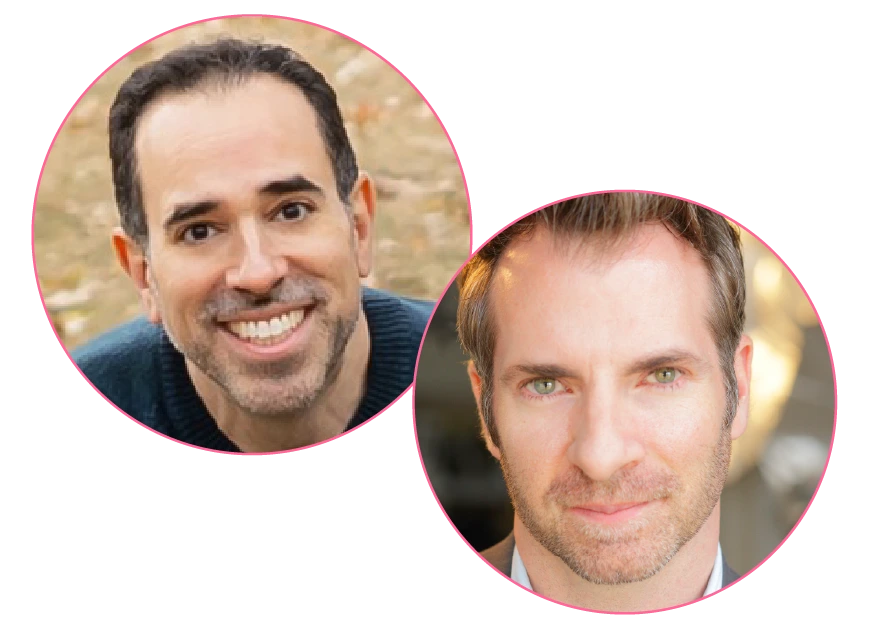
In this episode, we’re talking with playwright Jeremy Desmon and filmmaker Michael (Mikey) Forsch. Jeremy and Mikey do creative and production work on corporate live events. And they also have successful careers in other creative mediums. In this episode, they discuss how their work in one medium affects the other. And vice versa. So hit the download button, screw your headphones on tight, and get ready to take notes.
Read the transcript below and listen to this episode on Apple Podcasts, Spotify, YouTube Music or wherever you get your podcasts.
Show Notes
Our Guest
Jeremy Desmon is an award-winning writer whose work spans theatre and live entertainment. His musicals include Pump Up the Volume, The Last Supper, The Oliver Experiment and the Kleban Prize-winning The Girl in the Frame. He has written live shows for Nickelodeon, Universal, Disney, Sesame Workshop and Paw Patrol, and his comedies for schools — including Cyrano de BurgerShack, Andie Fowler’s Big-Time Bucket List and American History (in 60) among many others — are performed around the world. A graduate of Stanford and NYU/Tisch, Jeremy teaches Musical Theatre Writing at Princeton University.
Michael Forsch is a film producer, director, and casting director who, when not on a film set, can be found helping brands perform with Proscenium in the live events industry. His latest film credits include “Ruthless” (Starring Dermot Mulroney), the horror thriller feature film “Darkest Of Lies” (nominated best supporting actor) and “Attack of The Unknown (starring Richard Greico). As a Producer, his short film “Burro” won “Best Short Film” at the 2019 Hollywood Dreams Film Festival along with several other notable awards and nominations on the film festival circuit. His feature film “The Christmas Cabin” was voted the number one Christmas Movie in Nevada in 2021 and most recently his TV show, A-list Casting, won the “Best Pilot“ Grand Prize in the Silver State film festival and is currently available to stream on Youtube.
Credits
Hosted and Written by Jeremy Dobrish
Produced by Bethany Potter
Theme Music by Mike Mancini
Logo design by Shraddha Maharjan
Special thanks to Dossie McCraw
Transcript
Episode Transcript
Guests: Jeremy Desmon & Mikey Forsch
JEREMY DESMON: I just feel like corporate events really do demand the same things theater does, just with more LED screens and fewer tap breaks.
JEREMY DOBRISH: Hey there, thanks for tuning in. I'm Jeremy Dobrish, and this is the ProCast, brought to you by Proscenium Events in New York City. It's a podcast about corporate events. Each month, we take a bite-sized look at how to make corporate events, conferences, programs, and shows even more effective and impactful.
Today, we're looking at the live events industry from a different angle. We're talking with playwright Jeremy Desmon and film producer Mikey Forsch about how their skills in other creative mediums inform their work in live events, and vice versa. I've worked with both Mikey and Jeremy on corporate live events, and I've directed several of Jeremy's plays and musicals, and I've got to tell you, you won't find two more talented, dedicated, and fun people to work with. If you're intrigued and want to understand how these art forms play off each other, then stand by for cue one of the ProCast. Cue one, let's go.
JEREMY DOBRISH: So I'm here with playwright Jeremy Desmon and filmmaker Mikey Forsch, and I want to start at the beginning. How did you guys first learn that working on corporate live events was a potential job option for you? Mikey, why don't we start with you?
MIKEY FORSCH: I was in show business itself in Las Vegas, on the strip. I ended up leaving my show, it was called Jubilee, and I was looking around to find out what was next. One of the creative directors at Proscenium's own, Sam Port, reached out to me looking for dancers for a live event. A wondrous marriage was founded right then and there, because I asked Sam, "Hey, can I do some PA work for you? I'm looking for something to do." And from that, I've been working off and on with Proscenium for over 10 years.
JEREMY DOBRISH: Wow, that's incredible. Did you know that being a PA was something you were interested in, or did the opportunity just present itself and you leapt at it?
MIKEY FORSCH: It was one of those things where I just randomly came up with the idea: I need some cash, I feel like I'm already connected to what Sam is doing on this event, and I want to not just help with casting and finding the dancers, but continue on. And then I was like, oh, this is an industry I've never heard of, and it's awesome. Everybody is so on their game and ready to make something cool happen in no time. It's a lot different from having months and months of rehearsal like you do in live theater, or being on stage, or in film.
JEREMY DOBRISH: I love that. And Jeremy, I think I might know the answer with you, but how did you first get into it?
JEREMY DESMON: Well, as someone who writes plays and musicals, I worked with this incredible director, a guy named Jeremy Dobrish, for many years. We were having dinner one night and you said, "You know what? I think you'd be good at events. Have you thought about it?" And I said, "Tell me more." The more I learned about it, the more I realized it really is an extension of the same skill set, and it's such a great group of people who work in live events. It's all about putting on a show. You're all in, you're getting ready for the event to happen. I really fell in love with it. It was a match made in heaven, and I'm delighted that my director suggested me for it.
JEREMY DOBRISH: And we've been all the better ever since you came in, that is for sure. One of the reasons we wanted to do this podcast with you guys is that the chief creative at Proscenium, Chuck Santoro, is sort of an evangelist for this industry among theater people. He's a theater guy. All of his creative directors come from theater. He has this philosophy, which I agree with: here's this industry, it's really fun, really interesting, and it uses all the skills and talents any theater professional might have. But theater people don't know it exists as a profession, so he's often out trying to let young people know that if you're good at theater, this is a potential opportunity. So Jeremy, you came from theater as a playwright and started working in live events. How did your work as a playwright help you in this industry?
JEREMY DESMON: Both worlds are all about storytelling. One uses characters, and the other uses brands, but the goal is pretty much the same: to connect emotionally and make your audience lean forward in their seats. Theater is the first thing that taught me how to hold an audience's attention and guide them through a story, through an evening. I've always seen myself, metaphorically, as the dinner party host. I've invited you over to my house, with the audience members at Proscenium, and it's my job to guide you through an evening, to give you an experience, make you feel comfortable, and allow you to get what you want out of the evening. Corporate events really do demand the same things theater does, just with more LED screens and fewer tap breaks. It's still about a narrative arc: a beginning, a middle, and an end, and making people care about what you're saying.
JEREMY DOBRISH: It's so interesting. I wonder if the people listening are nodding their heads going, "Yes, I think that too," or if it sounds new to them. Because when you think about the CEO getting up to talk about how sales are year over year, and then the CMO getting up to talk about a new marketing initiative, it doesn't sound like a play. And yet we call our events shows, we look at them as shows, and everything you're saying about beginning, middle, end, narrative arc, characters, that is what we're thinking about, even if it doesn't seem quite intuitive. Now, Mikey, I want to ask you almost the opposite question. You were doing these events as an actor, as a performer on the strip, then you got into live event production, and you've gone on to produce and direct films. How has your work on live events informed your other creative work in film and television?
MIKEY FORSCH: That's a great question. Working with the producers and the production side of live events taught me a lot of lessons I've been able to transfer over as a filmmaker. In live events, you have to be so prepared and so detail-oriented. I've taken that into preparing my shows, because I'm an independent filmmaker. I don't have studio backing, so a lot of times these are lower-budget projects. The way to make up for that is being highly organized and highly professional on set, and those are just requisites when you're working in live events, because you're only as good as your last show. If the show doesn't go well, the agency producing it might not be brought back by the client. So everybody is always on point, always knows every little detail, always knows what the schedule is and where everything's going. I took that lesson to the indie filmmaking set, which can be a lot more lackadaisical, people who aren't working for studios and maybe don't have as much experience on big studio sets and need to be guided. I brought that professionalism, thinking ahead, and detail orientation to an indie film set. To bring in a sports analogy, we out-kick our coverage. We may have a smaller budget, but the products we're making are highly entertaining. Everything is buttoned up, it's tight, it looks good, it sounds good. That all comes from learning how to be that way in live events. It's been a huge influence in my life.
JEREMY DOBRISH: It's so interesting. I come from theater, and when I started working in this corporate world, the stereotype I had in my head was that business people would be efficient and on it and know what they're doing, and it was the theater people who would be airy and collaborative, working it out in the room. Boy, that is not the case. Theater people know how to stick to a budget. They know how to stick to a deadline. Opening night comes when opening night comes, not when you're ready for it. You need to be prepared, and theater people know how to do that.
JEREMY DESMON: They say shows are never finished, they open.
JEREMY DOBRISH: That's right.
JEREMY DESMON: I've always said that.
JEREMY DOBRISH: There's a Lorne Michaels quote about how we go on at 11:30 not because we're ready, but because it's 11:30.
BETHANY: This is behind-the-scenes Bethany breaking in with a fact check. Lorne Michaels is the creator and producer of Saturday Night Live. He's been nominated for a record-breaking 112 primetime Emmys, so he knows a little bit about how to finish a show.
JEREMY DOBRISH: Now, Jeremy, you were talking about bringing your playwriting skills to the live event space, and I have no doubt your live event work benefited from your work as a playwright. But did you find that, having done some live events, going back into theater, you brought something with you, that it had informed your work in some way?
JEREMY DESMON: That's interesting. I would say working in live events reminded me that theater, at its core, really is an event, if that makes sense. Sometimes as a writer, and sometimes in the theater, you can get precious or intellectual or in the weeds, or it's about being clever. But the audience at a corporate event is there to get the message. They're there for a point, and you have to say what you need to say and make it clear, visual, big, bold, and clean. Seeing and experiencing that in live events has come back to influence my work in theater. There's something about a corporate audience: they don't think they're there for a show, if that makes sense. They think they're there to sit and hear some stats. So there's something smooth and clean about keeping their attention.
JEREMY DOBRISH: Yeah. And when you talk about them not thinking they're there for the show, obviously if you bring in live entertainment or do something particularly creative, that feels like the show. But when the presenters are presenting their charts and graphs and year-over-year data, to me that still is the entertainment. That still is the show. The question is how you make that interesting and fun and engaging, because if it's not, they're not going to be engaged, they're not going to care, they're going to get on their phones. And why did we fly them all to Vegas and put them in a ballroom to do that? We've got to make the message entertaining. As a playwright, I can see that ruthless clarity being important. I'd love it if you guys have particular examples. Are there times when you were on a live event and thought, "Here's where I really used my skills from theater or film," or on a film set or in rehearsal where you thought, "Here's where I used something I learned in live events"?
MIKEY FORSCH: I have a particular experience. I was working for a certain home improvement company, and the producers approached me and said, "We need you to be a camera producer while we're doing our award show." And I said, "I know how to do that." I felt like that provided a lot of value to the company and to Proscenium, being able to hop into that role. I've worked with camera crews a ton. I knew how to talk to them and knew exactly what was needed for the job, because I'd done it a ton already. So it's very useful.
JEREMY DOBRISH: That's a great example. And that's another interesting thing about theater people. There are plenty of actors who are just actors, that's all they've ever done, but lots of actors have also been the lighting designer, the costume designer, they've run the light board, they've been an assistant stage manager. We all try to do all of the jobs to get a sense of what everybody's doing, and then when you're called upon to have those skills, you have them. What about you, Jeremy?
JEREMY DESMON: We did an event for a large company where employees of the company performed as part of a talent show. We had everyone send in videos of themselves breakdancing, beatboxing, BMX biking, singing. We had these two opera singers, and we put together an act for the two of them. We're in a ballroom in Vegas, preparing for the show, and there's a moment where she sounded beautiful, gorgeous, and we hit the emotional peak of the song. I just thought, there's something missing. She deserves applause. I looked at the music person running the room and said, "Mike, can we raise the key or something to make it more exciting?" He said, "I don't think we can." I said, "Is there an alternate note?" He said, "Nope, I don't think so." So I looked at her and said, "Okay, this is going to sound really weird." She said, "Go for it." I said, "Can you just make it look harder? You sound so good on that note, and it looks so easy for you. Can we put a little spin on it and just give it your all?" And she did it. She dug in and made it look like the hardest note she'd ever hit. I looked at her and said, "That's the applause." She said, "Okay, if you say so." And I'm telling you, it was the highlight of the evening. We were about to hit that note, I got nervous, she took a big breath, her face got a little pained, she hit that note, and 3,500 store managers went wild. It was so wonderful.
JEREMY DOBRISH: I love that story, and I know that feeling. We have it in theater. When you work with an actor and help them give a better performance, it's very gratifying. But there's also something special about when you work with someone who isn't a performer and help them give a better performance, whether it's literally singing or just giving their presentation. I had this the other day. I gave a presenter some notes, his presentation got much better, he felt it, the audience felt it, and he was so grateful. It's so gratifying when you can help somebody like that. So we might have already answered this, but were there any particular skills you can think of that apply to both corporate live events and the other work that you do?
MIKEY FORSCH: For me, there are so many similarities. They're doing a lot of the same things I'd do on a set. People are getting mic'd up, we're going over blocking, there's lighting, we've got to find the right camera angles. All of that is just skills you need in both. When you're putting together a live event show, you want to make sure the brand image is portrayed correctly, and when you're doing a television show, you want to make sure the story and the vision are portrayed and you don't get lost in the weeds going some other way.
JEREMY DOBRISH: Jeremy, anything you want to add to that?
JEREMY DESMON: Again, it's all about story. I always end up asking pretty quickly, "What's the story we're telling?" And even the most brilliant groups of people get a little flummoxed. They're so deep in the brand guidelines and the messaging that they forget: what story are we telling? It's an emotional arc, it's empathy, you're choreographing the attention of the audience. I find it's a complementary skill set to so many people in events. Proscenium is all about that, but at other agencies I've worked with, sometimes it's a nice complementary angle to come in and say, "Let's just talk about this. What are we trying to say, and how can we make sure the audience gets there?"
JEREMY DOBRISH: It makes an enormous difference when you get the presenters to think from that perspective, from the audience's perspective. It's less about what you want to say and more about what they need to hear. Sometimes just making that simple flip changes everything. Now, we've talked about brand a few times, and generally in theater you're not so concerned about brand, whereas in live events brand is super important. Can you talk a little about that difference? How does having a brand involved change the process?
MIKEY FORSCH: Working as a producer, you're always thinking about the director's vision, and your job is taking that vision for what the show should be and executing it as much as possible. There are a lot of parallels with client and brand. Your job as a producer or creative director is to thoroughly understand their brand, how things should look, how things should go, the way they like to do things. In the live event show, you have the right signage, the right look of the videos, the right color schemes, the way the brand presents itself. So I can take that lesson about branding, learning it from clients, and bring it over to: let's really listen to the director's vision, or as Jeremy keeps saying, what's the story the client wants for their brand? What's the story the director wants to tell, and how?
JEREMY DOBRISH: And Jeremy, what do you think?
JEREMY DESMON: From the creative director's point of view, having a brand involved is a creative constraint. And constraints don't kill creativity, they shape it. You don't get good results despite the limits, you get them because of them. They're creative guardrails, and I honestly love that. It forces you to be sharper. There's a quote attributed, or misattributed, to Orson Welles: "The absence of limitation is the enemy of art." I think that's totally true, in a rehearsal room or a boardroom. I've taught a writing workshop at Princeton for 15 years now, and whenever we give the students assignments, they always shine when you give them something very specific to write. If they can do anything in the world, it's generally not as good, but when they have something specific to focus on, a limitation, they thrive. It's always better. That's also what's so great about working with a brand. That's why we use the word "brand," because it's not just the name on the outside of the store. It's the energy it implies, the meaning of those words. Those are not the enemy of creativity. I think they're the engine of it.
JEREMY DOBRISH: I agree with all that. I would add, however, that in theater, film, and television, you have more brands than you might think. I did a show, and Jeremy, I know you have a lot of experience with this, for Daniel Tiger's Neighborhood. I wrote a draft and gave it to the director and producer, and they loved it. Then we gave it to the Fred Rogers people and they hated it, because there was so much stuff that was off-brand. This character would never say that, this character would never do that. You're just way off brand.
BETHANY: Behind-the-scenes Bethany again. The story does have a happy ending: Jeremy's musical of Daniel Tiger's Neighborhood has successfully toured the country for many years.
JEREMY DOBRISH: If you think about Star Wars or Marvel, these are brands. Big brands. And even if you take something like Hamlet, Hamlet is a brand in a sense. You can go off the brand guidelines if you like, but there is a brand to Hamlet that you have to think about if you're doing a production of it. So, speaking of Hamlet, I have a weird question for you guys. One of the things I think about in terms of the difference between theater and live events has to do with metaphor. If you're doing Hamlet, the audience is watching Hamlet, but they're not really investing in Hamlet. They're investing in themselves, in a way, through Hamlet. Hamlet is the metaphor through which we understand our own lives. Whereas in live events, I feel there's a little less metaphor. It's a bit more: this is you, this is your company, this is your CEO, this is your life, this is your year ahead, let's talk about it. That, to me, is one of the interesting differences you have to navigate. But I may be crazy. I'm curious for your take. Does that resonate, or do you have a different spin?
JEREMY DESMON: I've actually never thought about this before. It's a really interesting take. Obviously there's still a lot of artistry in it, but I think the artistry is probably in how directly you can communicate something and still make it feel theatrical and surprising. There's a clarity to what we do in live events that's a little different than in theater. The audience in a theater is there to let their imagination fill in the blanks, and the audience at a corporate event feels like they're there for information. So the artistry is in keeping things engaging and emotional. It's not about interpretation. Maybe it's more about the precision of getting across the message, the story, and the brand.
JEREMY DOBRISH: And I don't mean it as a value judgment. There's nothing to say metaphor is better, more interesting, or more entertaining. It's just different. Mikey, anything you want to add?
MIKEY FORSCH: When you brought this up, the thing that came to mind for me as a film director was, oh, he's talking about subtext. In a film, it's not necessarily the words you're saying, but the meaning behind them that everybody's so drawn to. A lot of actors might deliver a line one way but mean the total opposite. In live events, there's nothing like that. You mean exactly what you're trying to say the whole time. I think that brings almost a sense of vulnerability you don't always get in film. A lack of metaphor in live events can be refreshing in some sense. It's, this is who I am, this is what we are, this is our message, and I'm saying exactly what I mean. That can also be challenging, because if you're trying to get that message out and it's not reading with your audience, you have to figure out how to make that directness work and read to an audience in a good, succinct, professional, get-everybody-excited way.
JEREMY DOBRISH: It's interesting, you made me think of an event I recently worked on. The head of sales had a very specific philosophy for how he wanted certain messaging to come across. As he listened to the various presenters, if they ever said anything not quite in line with that philosophy, he'd give a note about it. It didn't change the meaning, the numbers, or the facts. It was just, "I don't want you to look at it through that lens, I want you to look at it through this lens, so that we're telling a cohesive story and we're all united in our messaging." He was very good and very clear at it, and he'd always catch someone presenting it slightly differently. So while it isn't subtext and it isn't metaphor, there are different ways to tell your story, different lenses through which to present information, and that's a big part of what we're looking for: what's going to be most effective for what we're trying to do. Okay, I want to bring this full circle. If you could go back to your younger selves, about to do your first corporate live event, is there anything you would tell yourself, anything you wish you'd known, any bit of wisdom or advice for that person stepping into the role for the first time?
MIKEY FORSCH: I would say pay attention to what the EP wants and what they're doing, because they know every little detail of what's going on. They're there for every meeting, they understand how much everything costs. So if I have a question no one else seems to have the answer to, I know the executive producer knows it or can get me an answer. If I'd learned more from the executive producers earlier on, I think I would have learned a lot more lessons about production and how things should be put together and run.
JEREMY DOBRISH: That is great advice. I love that. Jeremy, how about you?
JEREMY DESMON: When I first started working in live events, I was the theater guy. I thought my job was to come in and have big theatrical ideas, something clever, something punchy, something with a big wow factor. "This is why I'm here, this is what I was hired for." What I learned pretty quickly is that the corporate team you're working for has been thinking about this for a long time, and they have a very strong voice, a very strong goal, and a very strong instinct. The first step is sitting back and listening for a long time and really asking a lot of questions. What they're looking for isn't a silver bullet. They're looking for a creative partner who can help them see their own message from a fresh angle, something they haven't thought about. So it took a moment to stop and go, "Okay, hold on, I really have to understand where they're coming from, because every single person in this room has been thinking about this for a very long time." There's a lot of downloading that has to happen. So maybe the theater skill isn't theatricality, it's empathy. Maybe that's the big theater skill I needed to lean into right away. Once I honed in on that, it made the whole process that much clearer and more exciting.
JEREMY DOBRISH: That's great advice, and really interesting. It made me think of something. Mikey, earlier you were talking about the director's vision. What I love about directing theater is you're working with people coming at your show from a very specific perspective. The lighting designer wants to do the lights a certain way, in part because that's what will make the lighting look great, and the set designer wants the set a certain way because that's going to make it a really great set. As a director, you take these people coming with really creative ideas and figure out what's best for the show. When you're on a live event, you bring what's going to make it the most creative idea possible, but someone else decides whether the most creative idea possible is the right idea for this show. It might not be. It's just a very different way of looking at it. Chuck Santoro, our chief creative, has a saying: "Don't marry the creative." Meaning you might have a great idea, and you know it's a great idea and you love it, but it may not happen, because it might not be right for whatever reason. And you have to be okay with that. You're there to give the ideas, and we do what we end up doing. All right, I'd love to move on to our lightning round. These are three questions we ask all of our guests. You can answer them relatively quickly. The first: who is your biggest get? By that I mean a guest speaker, an entertainer, or a subject matter expert you'd love to see at a live event.
JEREMY DESMON: Going back into where I live, and with his life before he passed, Stephen Sondheim. He might not have been the most dynamic speaker, but he had a process. He was a craftsman. Corporate America is filled with people who are very good at what they do, and just seeing an artist talk about their craft, breaking it down, would have been really interesting. Someone like Lin-Manuel Miranda would probably be very good at that these days too. Someone who can take the artistic view on how to do it, how to break things down. And if I can't get them, how about Tom Hanks?
JEREMY DOBRISH: Sure, he's a go-to.
JEREMY DESMON: He is my go-to.
JEREMY DOBRISH: I love that. How about you, Mikey? Who would you love to see at a live event?
MIKEY FORSCH: For me, it would be a tie: I'd love to have either Aaron Sorkin, huge writer, or Shonda Rhimes, big-time showrunner, and just hear about their experiences creating these hugely memorable shows over and over again, and how to have that continued success. People consider their shows some of the greatest ever made for television. I'd love to learn about that experience and how it could apply in live events or a corporate setting. They're fascinating people, so wildly talented, so pro.
JEREMY DOBRISH: I love that. Let's get them. All right, second question. You've both seen plenty of executives and presenters up on stage giving their presentations. What is one thing you wish presenters did more of, or less of?
MIKEY FORSCH: Having a little more preparedness in what they're presenting. I've seen ones who are so prepared, who know exactly what they want, and even if they're making changes, they come up and own the stage and know the exact clear messaging of everything they're trying to say. It's such a huge difference, and it's such a pleasure. I'd say speaker preparedness. I know it's part of your jobs as creative directors to help with that, but sometimes there's just no time and they literally have to show up and do what's prepared. They don't always realize how important it is to be prepared, and sometimes they just go and wing it, and I'm like, oh no, he's meandering off into something else. What's happening? Everybody starts looking around, "Where are we going with this?" This is the most important thing in our world at that moment. There are 8 million things going on, but it's also super important, when corporations spend so much money on these events, that we all present as good a product as possible.
JEREMY DOBRISH: It's a great point, and that's one of the big differences. In theater, we rehearse. In live events, the presenters often don't want to rehearse. Mark Shearon, one of the founders at Proscenium, has a great point about this. He says presenters don't want to rehearse sometimes because they're afraid they'll look over-prepared, but the way to come across as spontaneous, ironically, is to rehearse. The giant of corporate presentations is Steve Jobs. He rehearsed like a maniac. He understood the importance of it, but he never looked rehearsed. He looked very natural. That's the magic of it. But it's about convincing people that it's important and that it's going to help them. Jeremy, how about you?
JEREMY DESMON: I would just say connect. Slow down, make eye contact. Don't talk at people, talk to people. Sometimes presenters get caught up in all the numbers and all the words on the slides and all the things they have to get across, when so much of it is just connecting and getting across the energy of what you want to say: we are in a good place and we can be better, we have a lot of work to do, here's where we're heading. It's a matter of stopping and looking at people. You feel it the moment someone slows down and connects with the audience and sees them. It's completely different.
JEREMY DOBRISH: That's a great point, and one way to do that comes back to Mikey's point about being prepared. One of the things that prevents people from connecting and looking people in the eye is that they're looking at their downstage monitor to get their script, and they're afraid to go off it and actually look at people. I always find, if someone comes out and the first thing they do is look down at the monitor and say, "Hi, my name is Jeremy Dobrish," oh my gosh, really? You couldn't tell us your name without reading it off a monitor? They're so nervous because they haven't prepared to just talk. They know what they want to say. So I completely agree. Okay, last question. What is something, a book, a movie, a song, whatever you like, that was a big influence on you, particularly on your career?
JEREMY DESMON: Music. I work in musical theater a lot, and there were a couple of pop songwriters and groups, Barenaked Ladies is one, Ben Folds is another. They were working in the medium of pop music, so it had to be catchy, it had to be ready for radio play, "don't bore us, get to the chorus." But they were telling stories, and they were undeniably themselves. They were funny, they were vulnerable, they were weird. These were artists who weren't afraid to say things the way they came out of their brains. They'd shape it and mold it, but they weren't dampening that spark. They weren't trying to be something they weren't, they were trying to embrace all that they were. That taught me that the most interesting things I can put forward are the ones that might be slightly out of left field, that make me laugh, that I find interesting. If you have the craft and put in the work and shape things, you can feel comfortable putting them on the page, on the stage, in front of 3,500 people in Vegas, if you believe them and they come from a pure place.
JEREMY DOBRISH: I love that, and I can totally hear it in your writing. Mikey, how about you?
MIKEY FORSCH: My career was really helped by doing improvisational classes and circus-style clown classes. I try to get as many people in the arts to take these kinds of classes, because they really help shape you, to be willing to be on your toes all the time, to come up with creative solutions, or create problems, which can also be a fun thing. Especially taking clown classes, it really helped me find myself. Not "look, I'm a clown, I'll make a balloon," but more that it helped me find a sense of vulnerability on stage and learn how to connect with an audience. As an artist, whether in live events, TV, or on stage, being able to be vulnerable and connect with an audience is pretty much everything everyone wants to get out of a show. It's amazing, it's super fun, and you laugh, that's the best part.
JEREMY DOBRISH: Are there any particular groups, classes, or books you would specifically recommend?
MIKEY FORSCH: I have two favorite teachers. Stefan Haves, a Cirque du Soleil clown comedy specialist and director, and I absolutely love training with Spymonkey, who are based in England. If you get an opportunity, just for fun, I say go take one.
BETHANY: This is behind-the-scenes Bethany breaking in with a fact check. Spymonkey are the UK's leading physical comedy ensemble, described as rooted somewhere between Monty Python, the Marx Brothers, and Samuel Beckett. Their debut show, Stiff, was about an undertaker so inept the corpses could never rest in peace.
JEREMY DOBRISH: That's great. We'll definitely link to those in the show notes. So before we go, you guys are always working on such interesting, varied, fantastic projects. I'd love it if you could quickly give us a sense. Mikey, what are you working on these days?
MIKEY FORSCH: Currently I'm working on a show I'm the showrunner on, which means I'm the lead producer who makes the show happen, and I'm also a co-director on it. It's called A-List Casting. It's similar to The Office, a mockumentary style, but it's set in Las Vegas. It's about two casting directors and their assistant who've been kicked out of Hollywood, so now they're stuck in Las Vegas, because when Hollywood spits you out, Vegas sucks you in.
JEREMY DOBRISH: And where can people find that?
MIKEY FORSCH: It's currently streaming on YouTube, and we'd love for you all to check it out. The complete first season is out there, and very soon we'll have season two making its debut later this winter.
JEREMY DOBRISH: Nice. We'll definitely link to that in the show notes. And Jeremy, how about you? What are you working on these days?
JEREMY DESMON: I have a number of projects, lots of irons in the fire. The main one is a rock musical I've written, based on a film from 1990, called Pump Up the Volume, the Christian Slater film. We've been talking to a couple of theaters and trying to put together a small tour for the show. It's very exciting. It's this incredible story about a kid who starts a pirate radio station in his basement in a very conservative town. What comes around goes around, and the story has become more and more relevant as the days progress. We've had a lot of interest, and I'm very excited about it.
JEREMY DOBRISH: That's amazing.
MIKEY FORSCH: I want to watch that.
JEREMY DOBRISH: Guys, thank you so much for taking the time to talk about this stuff. Whenever I know I'm working with one or both of you, my whole face lights up, because you're so delightful to work with. You're talented, you're passionate, you're smart, and you're really willing to get in there and do the hard work it takes to make these events come to life. So thank you again. It's been a pleasure.
JEREMY DOBRISH: Well, that was super interesting, talking to Mikey and Jeremy about how working in live events influences their work in other mediums. For me, there were tons of takeaways, but these are the four tops. Number four: whether it's theater, film, and television, or a corporate live event, it's all about creating a narrative arc with a beginning, middle, and end. Number three: the level of preparedness and organization needed for a live event will serve you well in other industries. Number two: working in live events forces a certain level of clarity in messaging that's applicable to other mediums as well. Number one: whether you're making a play or a corporate event, it's always important to ask what story it is you want to tell.
JEREMY DOBRISH: Look, I could talk about this stuff all day, and if you want to talk to us about your experiences in other mediums or anything about live events, check out our show notes for more info. There's lots of fun stuff in there. Or just go to proscenium.com and drop us a line. We'd love to hear from you, because at Proscenium, we help presenters do their best work in front of their most important audiences. As we like to say, we help brands perform, and I have a sneaking suspicion we can help your brand perform. And if you want to get in touch with Mikey and/or Jeremy, you'll find their contact info in the show notes.